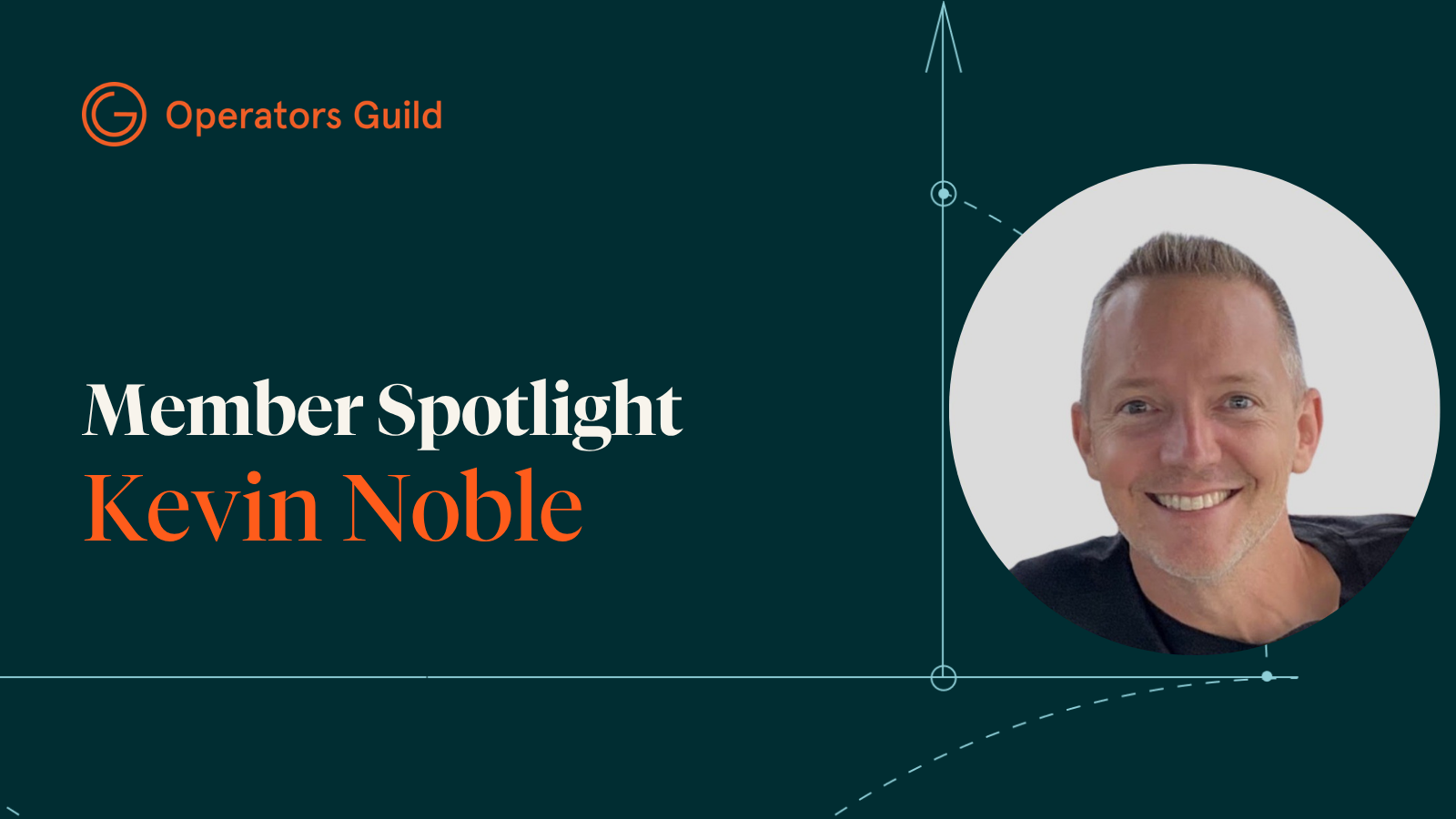
Kevin Noble spent 10 years at Atlassian before going independent. Here are the two bets that built his practice — and the lesson that surprised him most.
In two years on his own, Kevin Noble has built an independent operator practice spanning financial modeling, OKR systems, leadership coaching, process improvement, and custom software builds. He cleared $100K in year one, has six contractors, and is working toward his first W2 hires.
Before that, Kevin spent ten years at Atlassian, joining at ~1,000 employees and staying through the climb to 15,000 and the move from private to public. He is also the leader of OG’s affinity group focused on Entrepreneurship Through Acquisition, a path he believes more operators should know about.
Here, Kevin shares two bets that paid off and one lesson he learned along the way, and why the principles behind all three apply whether you're building independently or operating inside a company.
Bet 1: Refusing to niche down
From week one, people told Kevin to specialize. Pick a lane. Make it easy for others to describe what you do.
He heard all of it and largely ignored it.
The reasoning was operator logic, not naivety. Kevin's background spanned mechanical engineering, hardware ops, and software business transformation. He'd seen enough to know that inside a scaling company, problems don't stay in their lanes. Financial modeling becomes board prep. Board prep becomes OKR design. OKR design becomes leadership coaching. Leadership coaching surfaces org design questions. Scaling companies don't run short of problems, and a broad operator who keeps delivering can keep expanding.
That's exactly how it played out. The breadth that made his front-end offer hard to explain became a real advantage once he was inside a client relationship. He still acknowledges the tradeoff: getting in is harder without a sharp, simple offer. But once trust is established, the range is the moat.
Takeaways:
- Breadth compounds once trust is built
- Narrow offers travel faster but create ceilings
- Scaling companies always have more problems than clearly defined roles to solve them
The same principle holds inside a company. Staying narrow gets you siloed. Raising your hand across functions — especially in ambiguous, cross-functional moments — builds the kind of credibility that opens doors inside your current company and beyond it.
Bet 2: The wedge project
Fractional work is trust-based in a way that makes it genuinely difficult to sell cold. You're not selling a hammer. You're asking someone to let a person they don't know yet into high-stakes, systems-critical work. Kevin figured that out quickly and stopped trying to skip the trust-building.
His approach became straightforward: find a small, contained problem, offer to solve it, and deliver well. The cycle is simple. Notice a problem. Make an offer. Deliver on it. When that goes well, the relationship expands. A client who's seen you do what you said you'd do will bring you into bigger and more complex work. Trust compounds.
He's clear that this isn't a sales tactic. He's genuinely interested in the problem. He makes the offer because he thinks he can help, and then he has to go actually help. The delivery is what builds the relationship. The relationship is what builds the business.
Takeaways:
- Small, contained work lowers the barrier to entry in trust-based relationships
- Delivering consistently is more powerful than pitching ambitiously
- Scope expands naturally when trust is already established
The same principle holds inside a company. You don't pitch a major initiative cold. You find a visible problem, solve it well, and let the results open the next door. Kevin systematized this externally. Most operators do it intuitively. Making it intentional changes the scale of what's possible.
Lesson learned: people are the work
Kevin knew he could do the work. That was never the part he was most worried about.
For ten years inside Atlassian, demand came to him. He had an internal brand. People knew what he did. Work moved through the system toward someone who had already built trust.
Going independent changed that completely.
Outside the company, being good at the work was only one piece of the business. Kevin had to learn how to explain what he did, build relationships before there was an obvious project, and create enough trust that someone would remember him when a real need showed up three months later.
That part took longer than he expected.
He also learned the difference between networking and business development. Early on, he said yes to a lot of conversations that felt useful but never moved anywhere. Over time, he got more intentional. He still wanted to be generous and build real relationships, but he also needed to understand whether there was a path toward work, referrals, or mutual support.
For someone who describes himself as a lifelong introvert and non-networker, that was a real shift. The business wasn’t going to grow because he sat quietly, did excellent work, and waited. He had to put what he was building into the world, refine the message, and build a system for staying connected to people.
Takeaways:
- Being good at the work doesn’t automatically create demand
- Networking and business development are related, but they are not the same thing
- Trust-based work moves slowly until people understand what you do and remember you for it
- Relationships need the same intentionality operators bring to systems, process, and execution
The same principle holds inside a company. Strong operators often assume their work will speak for itself. Sometimes it does. But the people who keep expanding their scope are also making their work legible. They build trust across functions, explain what they are solving, and stay close enough to the business that people know where to pull them in.
Once an operator, always an operator
Kevin didn't develop these habits because he went independent. He developed them because he thinks like an operator.
He runs monthly business reviews on himself. He keeps weekly Friday reflections. He wrote SOPs for his own workflows before he had anyone to hand them to. He built an automated meeting prep pipeline using his Google Calendar because spending an hour a week doing it manually felt like exactly the kind of problem an operator should solve once and never have to think about again.
Kevin also leads OG’s Entrepreneurship Through Acquisition affinity group, a space he built for operators navigating the unique challenges of acquiring and scaling a business, where they can share what’s working and learn from others who’ve done the same.
A wedge project is how trust compounds, whether you're selling services or building internal influence. The breadth bet is how operators stay relevant and keep growing, inside a company or outside one. Knowing your floor is how you protect your time and do your best work instead of spreading thin across everything that comes your way.
The context is different. The principles aren't.
Want to learn alongside operators like Kevin?
Kevin joined OG because he needed a reason to connect with people that felt less forced than cold outreach. He found a community of operators who understood what he was building and were generous about sharing what they'd learned.
Operators aren't defined by one lane or one context. They're defined by how they think, how they build, and how much responsibility they're willing to carry. If that sounds like you, we'd love to have you in the room.