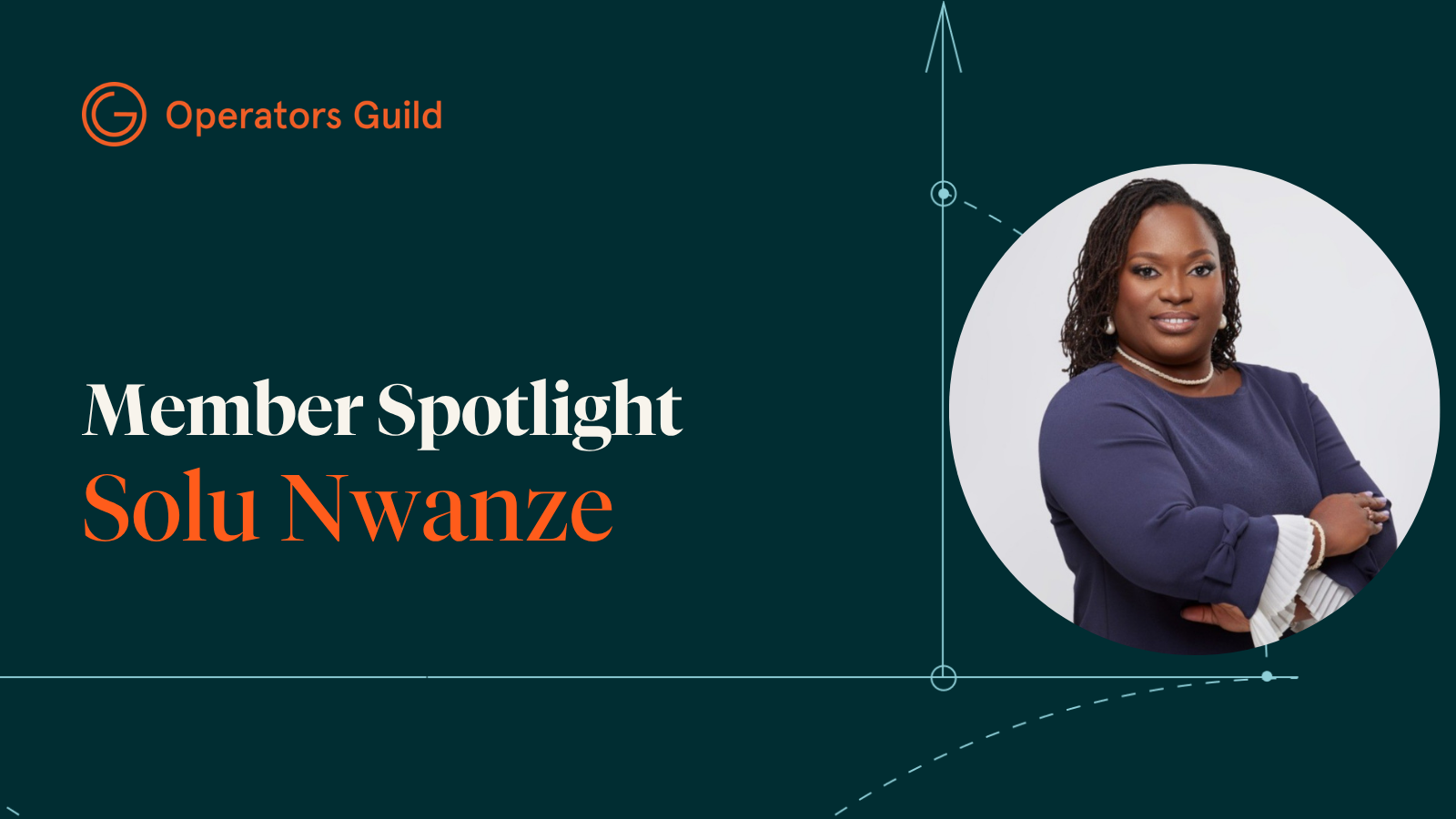
Insights from Solu Nwanze, VP of Operations and Chief of Staff at Reltio, founder of Teams Who Win, and member of OG.
Solu Nwanze activates leaders and architects the systems that move organizations forward. A software engineer turned business operator, she has led cross-functional transformations at Adobe and Zendesk, and is currently scaling enterprise AI capability as VP of Operations and Chief of Staff at Reltio. She is the founder of Teams Who Win, an organizational performance company that equips executives, chiefs of staff, and their teams with the skills and systems to lead boldly and create real organizational wins. Solu is based in Houston and is an Operators Guild member.
Could you start by introducing yourself and sharing a bit about your role and background?
I activate leaders and architect the systems that move organizations forward. That work shows up in two places.
I'm VP of Operations and Chief of Staff at Reltio, where I pioneered our enterprise AI transformation program through experimentation and organizational design, and recently transitioned the work into a hub-and-spoke operating model for scale. I also lead our M&A program, from due diligence to post-merger integration for the SAP acquisition.
The other half of my work is Teams Who Win, the organizational performance company I founded to equip executives, and chiefs of staff with the skills and systems to lead boldly and create real organizational wins. Our work spans three lines: IGNITE, our six-week accelerator for chiefs of staff at the emerging-to-established stage of their careers; fractional Chief of Staff and strategic operations engagements for executive teams navigating critical moments of transformation; and leadership labs that build alignment and drive results inside executive teams.
Both halves are the same practice. One inside a single company. The other across many companies.
What's your background, and how did you find your way into operations?
I started as a software engineer. I studied computer engineering and shipped code for the first chapter of my career, but the questions that pulled at me weren't technical. They were about the decisions upstream of the build. Why this feature, not that one. Why this market, not the next. Who decided, and what were they optimizing for. Business school was how I went after those answers.
The pivot into BizOps came at Adobe, in the middle of the SaaS business model transformation in Creative Cloud. That experience taught me what business operations actually is, at a higher altitude. Not just the operating cadence and the dashboards, but the work of holding a transformation steady while the company changes underneath you. That's the work I've been doing in some form ever since, across Adobe, Zendesk, and now Reltio. The companies and the transformations have changed. The shape of the work has not.
What role have mentors and advocates played in your journey?
The ones who shaped me most weren't formal mentors. They were leaders who were generous with how they thought, not just what they did. A philosophy shared in passing, a framework offered without ceremony, an introduction that opened a door I hadn't seen, or a question that widened my leadership perspective.
My biggest career inflection points came from advocacy, not mentorship. Someone who saw a capability in me before I'd named it, and made room for it. Adobe taught me that the most valuable rooms are the ones nobody invites you to. You find them, you ask for the seat, and you bring something to the table that earns the next one.
The most consequential decision I made in that period was to train as an executive coach. The leaders running the development programs I respected most were all ICF-credentialed. I followed the pattern, sat for the credential, and discovered that coaching wasn't an adjacent skill to operating. It was the operating system underneath it. Every senior role I've held since has been better for it.
What separates a good operator from a great one?
Two things, and they're related.
The first is the discipline to operate from curiosity instead of certainty. Operators are pattern-matchers by trade, which means we're constantly tempted to skip past the actual situation in front of us and apply the playbook that worked last time. Great operators resist that. They listen for what's specific, what's new, what doesn't fit. They're willing to be slower at the front of a problem so they can be faster everywhere else. The same is true for great engineers, by the way. The instinct to slow down at the right moment is what separates the good from the great.
The second is the capacity to hold the whole system. Most leaders, up to C-suite, default to depth in their own function because that's where their authority feels secure, even when their roles are scoped to span the whole company. Great operators do the opposite. They build for the organization, not for the function. They're as fluent in the dependencies between teams as they are in the work of any one team.
Any advice for first-time operators, or someone transitioning into the role?
Treat your first year as an apprenticeship in the business, not the function. The fastest way to be valuable as an operator is to understand the company at a level most of your peers don't, which means putting yourself in conversations across product, finance, engineering, GTM, and customer success until the connective tissue is obvious to you. The operators who plateau are the ones who stay inside the operations remit. The ones who compound are the ones who keep widening their field of view.
The other piece is peer infrastructure. At early-stage companies, you won't have the institutional resources of a larger organization, and you don't need them. What you need is a working network of operators who are one or two steps ahead of you. Operators Guild is built for that.
What do you do to keep growing professionally?
I deliberately keep my learning at the intersection of leadership and systems, and I make sure I'm sourcing from both sides at any given time. Operators Guild keeps me current on the operator and systems side. TroopHR keeps me close to the people and culture work. ICF anchors my coaching practice. The discipline is in the breadth and the depth.
Running Teams Who Win is its own engine. The chiefs of staff and executives I work with put me directly in front of the problems the industry is wrestling with right now, in real time, with real stakes. That feedback loop between practice and study is something I appreciate.
What do you like about Operators Guild, and what would you say to someone thinking about joining?
OG has the quality I look for in any community I invest in: it's alive. The conversations are organic, the cadence is real, and the questions members raise are the ones actually showing up in their work that week. That's rare, and it's the difference between a community that broadens your thinking and a community that just sits in your inbox.
The connection to FOG is the other piece worth naming. Operators investing in the tools operators use is a genuine premise, and the alignment between the community and the fund is a meaningful signal of how seriously the work is being taken. If you're considering it, the answer is yes.
What are you paying attention to as AI continues to shift how operators work?
The senior cross-functional operator is more exposed to AI than almost anyone in the org chart, and most of them haven't tapped in fully yet.
The work of an operator, understanding how the organization runs, connecting the pieces, designing the path from current state to future state, is exactly the work that frontier tools are getting better at, fastest. That's not a future-tense observation. That's now. Six percent of organizations are capturing significant value from AI today. The barrier isn't the technology. It's the failure to redesign how people work. That's operator work, and it's the highest-leverage place to be standing right now.
I built and led the enterprise AI program at Reltio through the early phases and recently transitioned it into a hub-and-spoke operating model to scale it across the company. That work, plus what I see across executive teams through Teams Who Win and in recent talks I’ve delivered on Leading AI Transformation, sharpens where I think operators need to focus.
Three roles matter in an AI-first organization: consumer, ideator, builder. You can start at any of them, and the path between them isn't linear. Consumers become ideators. Ideators become builders. Consumers go straight to builders. The progression is less important than where you end up.
For operators, the line is clearer. If you're an operator and you're still just a consumer of AI, you are not doing it right. You need to be an ideator or a builder, and if you're not the builder yourself, you need to be surrounded by them. That's the position that drives real organizational impact. Anywhere short of it is spectating.
The question I'd put to any operator reading this is: what makes your team relevant in three years? What does your team need to be doing, learning, and building so the answer three years from now is still yes.
That's also the work Teams Who Win does with executive teams ready to move past scattered experimentation. If that's where your organization sits, my door is open.